Russ Nelson's blog
[
Home
|
RSS 2.0
|
ATOM 1.0
]
Sat, 31 May 2008
Paul Osman wrote a letter to the Nature Conservancy, published in
their Summer 2008
magazine. In order to maximize his shame and embarrassment, I will
reproduce the letter in whole:
The "experts" missed the point in "The
Poverty Question." The real debate should not be how to bring
other people's standard of living up to our own; it should be how to
reduce our own standard of living.
For most people reading the glossy pages of your magazine (in a
home full of unessential luxuries), it is very easy to critique the
Africal boy cooking a monkey over a small, open fire ("Dispatch").
However, his overall impact on the environment is a very, very small
percentage of our own. We, not the world's poor, are the problem.
Bringing the world's poor up to our standard of gluttony will only
result in the complete and total destruction of the environment. The
debate should be how to reduce our gluttony and make us more like
them.
Signed, Paul Osman, Williamsville, Illinois
Regardless of the correctness of his issue or not, the Nature
Conservancy really would like to be in a position where it can act to
preserve critical habitat in countries where poor people have
political clout, e.g. India. For a fucking certified idiot like this
to express his opinion in the Nature Conservancy's official journal is
complete stupidity. THESE PEOPLE READ, YOU KNOW. And it's very, very
unlikely that they view their own poverty as something to be desired.
They're likely to tie the Nature Conservancy together with this
idiot's opinion.
As for the issue itself, if the Osman-Idiot wants to reduce his own
standard of living, nobody is stopping him. Voluntary poverty has a
long history among the self-righteous. For myself, I plan to be
self-wrongteous, and will continue to try to help everyone on God's
green earth to become as wealthy as I.
posted at: 17:39 |
path: /economics |
permanent link to this entry
Fri, 30 May 2008
Apparently no cost is too high to protect the environment. You
know those little inhalers that asthmatics use to STOP FROM DYING?
They are powered by compressed CFC gasses. Apparently these
environmentalist fuckers feel that asthmatics should fuck off and die.
Because, you see, the replacement for CFCs, HFAs, doesn't work as
well. They will taste and feel different. The spray may feel
soft. Each must be primed and cleaned in a specific way to
prevent clogs (this is the serious one). And they tend to cost more.
These people disgust me.
posted at: 17:19 |
path: /economics |
permanent link to this entry
Thu, 29 May 2008
Ride starting Thu May 29 16:44:32 2008
13.15 km 43136.11 feet 8.17 mi
2219.00 seconds 36.98 minutes 0.62 hours 13.25 mi/hr
Massively windy spring day. Not a cloud in the sky, although it promises
to rain in a day or two. Dead-headed the last of the daffodils. We have
many many "normal" daffodils, and two mutant daffodils. One of them has two
or sometimes three flowers per stem. The other has a rose-like flower. There
is no center cylinder like most daffodils have. Instead, you have what I call
a "shattered" daffodil, where the petals spring out wildly from a central
core. And I noticed that they don't form a seed head. No need to dead-head
them since there's no seeds growing. Weird!

posted at: 21:38 |
path: /bicycling |
permanent link to this entry
The F.X. Matt brewery in Utica, NY, suffered a fire on Thursday. It's
a serious problem for them because it's their canning operation. They
presumably have insurance, but of course the problem is that they can't
sell any product until they rebuild. This is going to be hard for them,
but they will recover.
Unfortunately, you also have these assholes sticking their noses in:
Gov. David Paterson's office and the Empire State Development
agency are already pledging aid. The Oneida County executive, state
legislators and Utica's mayor also talked Thursday night of finding
ways to assist F. X. Matt recover and rebuild.
This is mercantilism! This is BAD, folks! Governments don't know how
to run businesses. They don't know this because they get paid by taxpayers.
Taxpayers MUST pay their taxes regardless of whether they like
the government or not. Their only alternative is to leave. Voting against
taxes is ineffectual. We voted down the school budget for next year, and
yet the State of New York allows them to run with a provisional budget
ANYWAY in spite of the voter's preferences.
F.X. Matt will rebuild. Government will help them. But don't confuse
this with capitalism. It has the stink of mercantilism, through and through.
posted at: 16:08 |
path: /economics |
permanent link to this entry
Since March of 2002, I've bicycled 24 million feet, 7.3 megameters, or
4536 miles, depending on how you want to say it. Wow.
posted at: 06:52 |
path: /bicycling |
permanent link to this entry
Wed, 28 May 2008
Eleanor Gibson, Norwood, is quoted in the local free weekly (North Country This Week) as saying
about gasoline prices "Something needs to be done, an investigation into
this -- it's ridiculous."
Did she complain about low oil company profits when gasoline prices dropped?
Probably not. So why does she think she has the right to complain when
gasoline prices have gone up? Arguing for your own interests over those of
other people is called "selfish".
I always have to wonder quite what people think can be done when
they say "Something needs to be done"? Do they think that Congress can
repeal the law of supply and demand? One might as well try to repeal
the law of gravitation. There are very concrete causes for the increase
in gasoline prices. It comes down to having to pay more than anybody else
wants to pay.
I suspect that people think that Congress and the President run the
economy, and can turn prices up, or down, as they wish. They should be
careful what they wish for. Our current health care mess was caused by
wage and price controls during WWII. Wages were limited, so to attract the
best employees, employers bought them free health care. After the war was
over, employees took free health care for granted. Health care was still
affordable then, because most people paid for it out of pocket. Now that
very few people have to pay their own medical bills, they don't care how
much health care costs, so they don't care to economize, and the medical
industry is happy to oblige their spendthrift ways. Everybody complains
about how the insurance companies don't want to pay for anything. If people
were paying their own money, they wouldn't want to pay for
anything, and the medical industry would find itself needing to keep
the cost of health care low.
posted at: 05:13 |
path: /economics |
permanent link to this entry
Sun, 25 May 2008
22.66 km 74335.76 feet 14.08 mi
3858.00 seconds 64.30 minutes 1.07 hours 13.14 mi/hr
I broke my rim on the previous ride. Pulled a spoke head right through
the rim. Oops. $90 later I have a new wheel. Also put on a red blinky
taillight. Had to pull off the seat to get it on, and I noticed that
the seatpost "MAX HEIGHT" marker was much lower than I thought, so I raised
my seat. WOW, what a difference it made. Not only did I feel much
stronger, but my butt hurt less. I think that with the seat higher, I'm
putting more weight on my legs and less on the seat. Regardless, I
feel like Mr. Super Bicyclist today.

posted at: 22:01 |
path: /bicycling |
permanent link to this entry
Many people who believe that we should be thinking less of ourselves,
and more about the future, cite the Iroquois maxim of thinking "Seven
Generations" ahead. Why seven? Why not eight? Economists who have
studied this issue call that number the result of the discount rate.
People discount the future. Not entirely, and not all at once.
Life is uncertain, and with the passage of every bit of time, your plans
have a chance of being disrupted. After enough bits of time, the
chances of being disrupted add up to a probability of one. Beyond
this time, you cannot plan, and you SHOULD NOT plan.
How do you determine the discount rate? As it turns out, the discount
rate is proportional to the (natural) interest rate. That rate is what
people charge to lend money. Getting paid back is a plan, and those plans
could be disrupted because of unforseeable future events, so people insist
on being paid back more than they have loaned.
People's discount rate is roughly equivalent to the inverse of the level of
civilization in which they find themselves. Every sane person wants
the discount to be as low as possible, and the level of civilization
as high as possible. Political action increases the
discount, because it makes people's plans less likely to come to
fruition. That's why, when economists say that they want a small
government, what they really are saying is that they want a prosperous
society.
posted at: 17:10 |
path: /economics |
permanent link to this entry
Sat, 24 May 2008
Those who say "people before profits" fail to understand why profits
are important. Profits tell you that you aren't wasting resources --
that customers value what you are creating, over and above the cost
of doing it. Without a system of free enterprise, private property,
and capitalism, you can't tell how much to pay your workers, how to
price your products, how much to build vs buy, how much to make in
one day. I can't imagine what mechanism these people would use to
replace the decision-making power of profits.
posted at: 06:00 |
path: /economics |
permanent link to this entry
Tue, 20 May 2008
23.31 km 76486.92 feet 14.49 mi
6052.00 seconds 100.87 minutes 1.68 hours 8.62 mi/hr
Went west on the Rutland Trail from
Knapps Station, into Norwood, cut through the CSX "yard" (which is actually
just one siding, down from twenty many years ago), north along the New York
and Ogdensburg tracks, and then back to Knapps Station.

posted at: 00:46 |
path: /bicycling |
permanent link to this entry
Mon, 19 May 2008
26.29 km 86248.47 feet 16.33 mi
5960.00 seconds 99.33 minutes 1.66 hours 9.87 mi/hr
Rode on the Glens Falls Feeder Canal Trail, and the old Champlain
Canal Trail. At the north end of the Champlain Canal Trail, it dead-ends
at Bend Creek. Doesn't get much use for that reason. The other direction
heads towards Fort Edwards. You can still trace the route of the canal
through most of Fort Edwards.
Could have turned back and rode back on the trail (which would have been
fun), but I decided to come back on the roads. The weather wasn't looking
good, was predicted to rain, and I had a computer install to do at my
mother-in-law's.

posted at: 19:17 |
path: /bicycling |
permanent link to this entry
Sat, 17 May 2008
1.92 km 6310.10 feet 1.20 mi
2056.00 seconds 34.27 minutes 0.57 hours 2.09 mi/hr
Sigh. I attempted to bicycle the Tahawus (North Creek) branch of the
D&H, starting at Rt28. There was a fair bit of brush, both overhanging
and growing within the grade. I could have dealt with that, however, the
ballast was not well-regulated and the bike tire kept hanging up in the gaps
between the ties. I ended going up just past the curve.
That could be a really nice place to ride a railbike, however. It's all
very pretty woods. Found a couple of interesting things: there are some
broken-open batteries presumably spewing lead courtesy of acid rain, sitting
next to a battery box. The old telegraph line is still in place, sticking
up with its wires through the trees and brush. A ten foot section of rail
was sitting off to one side. The maker's date is 1924. Lackawanna OH
process.
There's much less overhanging brush and brush within the grade on the
south side of the road. A stop sign facing back along the railbed says
that snowmobilers use that part. Broken and trimmed branches says that
some of them continue on the north side, but they can't be having too
much fun. They ought to come through in the summer and trim back the
brush. Their efforts would be repaid in the winter with a pleasant ride.

posted at: 19:10 |
path: /bicycling |
permanent link to this entry
26.61 km 87316.03 feet 16.54 mi
4652.00 seconds 77.53 minutes 1.29 hours 12.80 mi/hr
Went out to Stockholm Center on US 11, and back on Reagon Road. As an
experiment, I recorded an audio file of
the ride, and my musings / mutterings / maunderings. One of these days,
I need to go between Wells Road and Old Forge Road, which is probably
real prickly ashy, but worth a try.
I speculated that a hill on the horizon might be Lyon Mountain, but
it's more likely to be Debar Mountain. The hill that I guessed was
Azure is very likely to be such.

posted at: 02:57 |
path: /bicycling |
permanent link to this entry
Fri, 16 May 2008
40.02 km 131284.94 feet 24.86 mi
7435.00 seconds 123.92 minutes 2.07 hours 12.04 mi/hr
I've been wanting to do this ride for a while. I've done every one of
those roads before, but not in this combination. I noticed that I could
go out the one road, hit US11 for a little bit, go out along the other side
of the river, then back on US11 for a little while longer, then back to
the West Branch of the St. Regis River again, then back to US11 yet
again, and finally head home.
. That covers nearly every road in the
triangle between US11, US11B, and the Stockholm-Southville Road. There'
one abandoned road which I've never tried to ride on, mostly because it
doesn't seem to go through anymore. I'll try locating the other end using
my GPS receiver, just to see for sure.
I bicycled 105.7 miles this week. If you count last Saturday's ride
as being with the period which is 7*24 hours, I rode 118.6 miles.
Audio of the ride.

posted at: 18:35 |
path: /bicycling |
permanent link to this entry
Wed, 14 May 2008
25.74 km 84447.04 feet 15.99 mi
6957.00 seconds 115.95 minutes 1.93 hours 8.28 mi/hr
Went into West Stockholm to mail off a package, and into Potsdam to drop
off a newsletter at the meetinghouse. A gorgeous day in Northern New
York. Started the ride with 5% clouds, ended it with 1%. The sun was warm,
the air was cool, couldn't ask for more.

posted at: 04:52 |
path: /bicycling |
permanent link to this entry
Tue, 13 May 2008
21.89 km 71821.76 feet 13.60 mi
3692.00 seconds 61.53 minutes 1.03 hours 13.26 mi/hr
Went into town for ... no reason at all. Just to ride. Stopped by
Heather's place of work (Myler Chiropractic).

posted at: 21:49 |
path: /bicycling |
permanent link to this entry
Mon, 12 May 2008
I think David Isenberg is a little frustrated with me, because he
keeps
snarking at me about economics. The problem is that not only does he not "get it", he doesn't understand that he's not getting it. It's like the guy
who adds 2 plus 2 to get 5, and then when you say that he's bad at math,
he says "Oh yeah? Well I know that 3 plus 4 is 8!"
From the looks of things, David is good at finance -- at least that's what
his later posting is about. Trouble is that finance is not economics.
Finance tells you how much, but economics tells you why. Finance can let
you determine that two things have the same value, or the same cost,
but only economics can tell you why people would buy one versus the other.
This seems to be a fairly commonly executed fallacy. Many many
people feel free to criticize economics and economists, when it's clear
that they don't know the first thing about economics. I think that's because
they, like David, confuse finance for economics. They figure that they can
balance their checkbook, so they know as much as somebody who has studied
economics for years and year. At least, that's my best guess, but I
might be wrong.
posted at: 06:43 |
path: /economics |
permanent link to this entry
Sun, 11 May 2008
55.78 km 183015.11 feet 34.66 mi
12577.00 seconds 209.62 minutes 3.49 hours 9.92 mi/hr
Wow, what a great ride. Of course, I got back in at 8:50PM ... perhaps
a little late given that I'd lost most of the light at 8:35. But I was on
back roads at that point and nobody overtook me (I would have gotten off
on the shoulder if they had).
Rode from Knapps Station to North Lawrence on the Rutland Trail. I wanted to see the nice
new bridges that "they" had put in. Here's one of them:
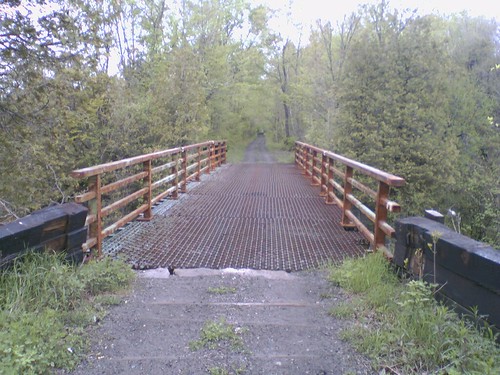
I had heard that Harry Dow (et al) had purchased a section of the trail,
but I didn't realize that it was the closed section. This is great stuff!

posted at: 02:12 |
path: /bicycling |
permanent link to this entry
Fri, 09 May 2008
20.42 km 66992.06 feet 12.69 mi
6143.00 seconds 102.38 minutes 1.71 hours 7.44 mi/hr
Went for a ride on the Christopher Muka section of the Rutland Trail.

posted at: 03:45 |
path: /bicycling |
permanent link to this entry
Thu, 08 May 2008
33.08 km 108514.70 feet 20.55 mi
6387.00 seconds 106.45 minutes 1.77 hours 11.58 mi/hr
Rode out to a friend's house on Bagdad Road. Upwind all the way out,
and on the way back, the wind was pushing me up the hills.

posted at: 15:04 |
path: /bicycling |
permanent link to this entry
Mon, 05 May 2008
David Isenberg drives me batty. He's the fellow who pointed out that
a stupid network (intelligence at the edges) produces more public benefit
than the smart network that his then-employer, AT&T, was building.
Well, of course when you make a public fuss like that, you either change
your employer's direction, or you have to leave. He left, and has been a
successful consultant since then.
Unfortunately, David doesn't know much economics. Like most people
who don't know much economics, he feels free to cast aspersions on what
he calls junk economics. He complains therein that some of his friends deny the
peak oil hypothesis. Maybe he means me? I don't deny the hypothesis in
the sense that I'm not an expert on oil. I have been studying economics,
however, and can make some predictions which counter David's "Junk"
economics.
First is that there are sources of huge amounts of oil which are not
profitable to extract when the Saudis are dumping oil. Second is that
nobody is going to invest in these oil sources unless it looks like they
can successfully sell their oil. So they're not going to act simply
because the price of oil is high. Everybody expects the Saudis to try to
push the price of oil up to extract the maximum possible profit.
But if the Saudis are artificially restricting the supply of oil,
they can artificially expand it as well. The people sitting on more
expensive oil are going to wait to extract it until they're sure that
the Saudis can't screw them by expanding production.
As I said at and after David's WTF
conference back in 2004, people will not act simply because experts say
that peak oil has occurred on such-and-such a date. People will act when
they wish to avoid discomfort and not before.
Yes, the end of cheap oil is going to be a challenge. But it's not going
to be the end of the world. Probably the only bigger challenge we'll face as
a species is the global cooling of the next ice age. That is going
to be a problem when the ice starts covering the northern hemisphere.
UPDATE (since a friend pointed out that I hadn't made my point) 5/5.
The world lurches from crisis to crisis. You might think this is a
sign of mismangement, a flaw in human nature, or simply God screwing up.
(As for the last, I believe that God stops in from time to time to see if
we've blown ourselves up yet, so he can promote the great apes, but that's
the extent of his involvement in the world.) Regardless of your opinion,
that is how people work.
In these crises, many people take different actions to try to resolve
the crisis. People fitting underneath a bell curve, they will try all sorts
of things. Some of them work, some do not. Sooner or later, a smart
person invents something that totally crashes through the crisis. Blows
it apart. The crisis is gone, and what we have is better than what we
had before the crisis. For example, a hundred years ago, New York City
was fast approaching a crisis of equine proportions: piles of horse shit
in the streets, and no place to put them. "We" invented the automobile,
and have experienced huge benefits in personal mobility.
The key to remember is that nobody can predict who will invent this new
thing, nor what it will be. In order to facilitate this solution to the
crisis, the best thing government can do is: nothing. Don't favor anyone
or anything, let everybody do everything, don't stop anything that's peaceful.
You may ask yourself, "but why don't we get the government to do something
to avert these crises before they become full-blown crises?"
The answer is simply that the government is doing something. It
is actively maintaining the peace. It is choosing not to interfere with
peaceful human relations. It is choosing not to favor one solution over
another. Choosing not to choose is a choice -- probably the
hardest choice to make.
UPDATE 5/12: David doesn't have much
to say about this post. I think he is trying to
trivially refute me by pointing to the fact that I don't think much of
some people who call themselves economists. I've been saying that all along.
posted at: 15:20 |
path: /economics |
permanent link to this entry
Usually, customers seek the maximum value at all times. This could mean
paying a lot for very high quality, or paying a little for something that
barely suffices. But customers optimize for value -- bang for the buck.
In the American health care system, nobody is optimizing for value.
The patient demands the highest standard of care regardless of the cost.
The insurance company demands the lowest payments regardless of the quality
of the care.
This is totally wrong. We need to move to a system where most people
pay most medical bills out of pocket, and insurance companies step in only
when the costs are completely unaffordable. To get there, we need to eliminate
the deductibility of health care costs. Why should health care be deductible
on income taxes when food is not? Food is way more important
to your health than is a doctor's care. So is exercise, but neither one is
deductible.
We also need to accept that most insurance companies will need to fire
most of their employees, and that doctors' offices will need to fire one
or more employees. On the bright side, consider that that will free up
their labor for production that makes American society better rather
than worse, as is currently the case.
posted at: 14:49 |
path: /economics |
permanent link to this entry
Sun, 04 May 2008
13.79 km 45249.84 feet 8.57 mi
2829.00 seconds 47.15 minutes 0.79 hours 10.91 mi/hr
Just a short ride "around the block", but I also found out where is the
access road for the cell tower they put in last year -- at the end of Dudy
Road on the top of a 440' tall hill. That's surprising, because there
are hills very close by which are 50' taller. Maybe they liked this
hill because it's close to a road and also has no trees?

posted at: 05:35 |
path: /bicycling |
permanent link to this entry
I recently got myself a Flickr Pro account,
and have been using Flickr for more of my photos. I find myself more
and more annoyed at the rough edges in the Flickr user interface. For
example, when you want to delete a tag from something, you click on
the [x] to the right of the tag. Flickr asks you "Do you want to
delete the tag?" Cancel/Ok:
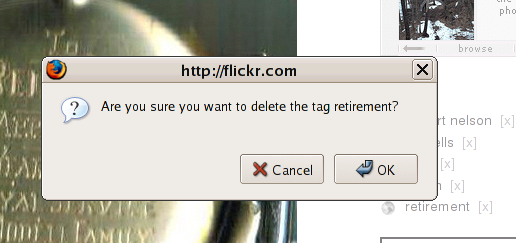
This is almost certainly the wrong thing to do. It annoys people
because the website is (in effect) saying "Hey, that might be a stupid
thing to do, so I'm going to slow you down so you can think about it."
The first couple of times people might pause to think (but what
they're likely thinking is "you stupid computer, I told you
what to do".) After that, when they want to delete a tag, the action
will be "Click X; Click Ok", with no pause for thought.
That is how people think. That is how people are able to learn a
complicated game like chess, or go. People chunk information and
actions together. This allows the forebrain to go on thinking about
other things while the rest of the brain carries out an action
previously decided-upon. If an action requires a confirmation, the
hindbrain will confirm it as part of executing the action chunk.
The way to work with human congnition rather than against
it is to allow for Undo. Undo isn't a new idea -- we were using it 25
years ago. Undo works well with the human brain because it allows
actions to happen without confirmations, but it also allows the
forebrain (which operates slower than the hindbrain) to realize that
it has made a mistake, and correct it with an Undo.
Flickr isn't all bad. They do use Undo sometimes:
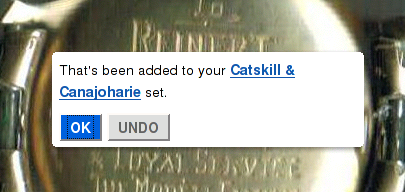
When they add an image to a set, they add an indication that it's
in the set over on the right, so the "OK" part is useless. They
should skip the dialog entirely and insert a temporary "UNDO" below
the set listing. Even when they do use UNDO, they spoil its operation
with a confirmation:

Of course I want to
remove it from the set! That's why I just clicked on UNDO, right?
Following the confirmation is another useless "Click OK to indicate
that you are still alive" box.
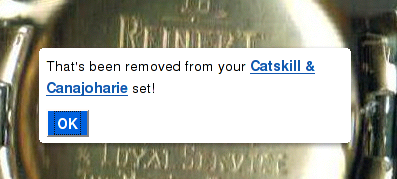
Of course it's been
removed, because the set listing is now gone. The proper way to
handle this is to grey out the set listing on the right, and add an
"UNDO" button below it.
Even if you've implemented your website using Open Source software
like Linux, Apache, MySQL, and PHP, you don't escape the low quality
typical of proprietary software unless your software is Open
Source.
It's easy to volunteer other people to fix problems. In the Open
Source world, the typical response is "great idea; send a patch."
Flickr lives in the Web 2.0 world, not the Open Source world. Their
software sucks just like any proprietary program. We can't fix it.
Only Flickr can fix it, and hopefully, they'll at least fix the
problems I've outlined here.
posted at: 04:56 |
path: /opensource |
permanent link to this entry
