Russ Nelson's blog
[
Home
|
RSS 2.0
|
ATOM 1.0
]
Sat, 28 Oct 2006
In a comment to a Marginal
Revolution posting, Mike Huben says that the "destruction of jobs
by minimum wages" (his scare quotes, not mine) is essentially
unmeasurable. He adds "I'm leery of believing either of those
conservative excuses. I'm much more likely to believe that the rich
want to get good servants cheap."
I hope nobody thinks I'm taking advantage of Mike by asserting that
he thinks minimum wage laws create no unemployment simply because said
unemployment is essentially unmeasurable. And yet, the noise caused
by a tree falling in a forest is essentially unmeasurable. Does that
mean that trees never fall, or that, when falling, they make no noise?
Far from it. We can see that trees have fallen and since we hear a
great noise when one does fall, we must assume that trees that fall
when we're not watching also make noise.
Thus, we have to assume that minimum wage laws cause unemployment
even though the unemployment we observe in a society cannot be tracked
back to the existance or passage of a minimum wage law. Or, at least,
if we are to be honest people we must make this assumption.
posted at: 08:12 |
path: /economics |
permanent link to this entry
Thu, 26 Oct 2006
20.77 km 68148.54 feet 12.91 mi
5723.00 seconds 95.38 minutes 1.59 hours 8.12 mi/hr
Went up to Norwood today, to look for an old track in the railroad yard.
I went to the place I thought it was, and yes, it surely looks like there used
to be a track there, more than 100 years ago. Over time, railbeds that used
to look pretty sturdy get their rocks and soil moved around by plants and
erosion. Plus the ties they used rotted fairly quickly (10 years) and often
weren't ballasted. Go look at the aerial photo
and judge for yourself. Looking at it in person, there is definitely a hump
where it looks like a track curving to the south.
Stupid GPS lost its fix until I turned the corner onto Route 56, so
the trip was more like 16 miles than the 13 my GPS receiver recorded.

posted at: 05:24 |
path: /bicycling |
permanent link to this entry
Sat, 21 Oct 2006
Doc
Searls links to George Lakoff's Whose Freedom?, Daniel
Pinker's review trashing the book, and George's
response. Sorry, Doc, but Pinker definitely won this argument.
Just take positive rights (the right to something good) and negative
rights (the right not to be subjected to something bad). George
totally gets them wrong. Here's what he wrote:
In Whose Freedom?, I discuss the difference between
freedom from and freedom to (page 30). Then, throughout the book, I
show that both the progressive and conservative versions of freedom
use both freedom from and freedom to. For example, progressives focus
on freedom from want and fear, as well as from government spying on
citizens and interfering with family medical decisions; they also
favor freedom of access to opportunity and fulfillment in life (e.g.,
education and health care). Conservatives are concerned with freedom
from government interference in the market (e.g., regulation) and they
are concerned with freedom to use their property any way they want. In
short, the old Isaiah Berlin claims about the distinction do not hold
up.
Clearly George has no conception of the difference. The "freedom
from want and fear" are both in fact the freedom to coerce somebody
else into supplying resources to satisfy your wants, and coerce
somebody else into protecting you. That's backwards. His "freedom of
access to" is an attempt to wiggle out of saying "freedom to coerce
others into supplying you with" (education and health care).
The "freedom to use their property" is in fact a freedom from
interference. Again, he gets this totally backwards, and yet not only
expects us to believe him, but he uses these as evidence that he
understands the concept after Pinker says he doesn't. That's like (to
use a metaphor) saying that you understand math, being challenged on
it, and then saying "Oh yeah?? Well two plus two is five; anybody can
see that I know math."
Doc calls it good reading. I call it painful reading, because
George is making a fool of himself.
posted at: 06:40 |
path: /economics |
permanent link to this entry
19.65 km 64476.42 feet 12.21 mi
9269.00 seconds 154.48 minutes 2.57 hours 4.74 mi/hr
Rode with five others on an ADK ride on the Rutland Trail. Rain was predicted and we
weren't disappointed. Started to rain just as soon as we left the Norwood
Post Office (the marshalling point). At first it wasn't bad since it was a
light rain and below freezing so it just bounced off. It had rained all week
prior to the trip, so the trail was nice and wet; about as wet as springtime.
Plus some beavers had cut down trees just about where the X is drawn on the
track, so we had to skirt them. Hopefully the ATVers will cut them before
they get frozen down to the ground; otherwise the snowmobilers will have a
disappointing season. By the time we got to Blind Crossing Road, it was
raining pretty steadily and the consensus was to head back. Could have gone
on the road, but we stuck to the trail (except for the muddy mile). Decided
to go on the road rather than have to climb around trees again. Got
thoroughly soaked and frozen. Hopped in the tub after I got home, and it took
about an hour for my skin to lose its raw red appearance.

posted at: 06:10 |
path: /bicycling |
permanent link to this entry
Tue, 17 Oct 2006
People who are not familiar with the operation of free markets
object to the statement "the market allows for efficient allocation of
resources". They look at their own life, or their friends' lives, and
see all sorts of inefficiency. Efficient is relative, though. It
should really go: "free markets provide the most efficient allocation
of resources". The difficulty is that the problem is ineffably hard.
Ever tried to pack suitcases into a trunk? Now imagine 300,000,000
trunks and several times as many suitcases, where the drivers are
moving the trunks around and the suitcases are changing size. The
difficulty of the problem is beyond the imagination, much less any
solution to it. The best solution is not going to be found in
standardizing suitcases or stopping the drivers from moving. The best
solution is to allow the drivers to choose the suitcases that best fit
their trunks.
posted at: 05:50 |
path: /economics |
permanent link to this entry
This sounds totally creepy: Imagine a mother, saying to her child
"Come play with me, honey; Daddy is healing his cut."
You can't imagine anybody saying that, can you? That's because
western medicine completely ignores the conscious mind. You can find
hundreds of stories of doctors talking about the patient as if the
patient wasn't there. And yet there is plenty of evidence that the
conscious mind can very effectively participate in healing the body.
Everybody knows of the placebo effect, I hope. That happens when a
doctor (or some other medical authority) gives the patient an
innocuous substance and explains the effect that the substance will
have on the patient. For some described effects, to an extent, and
for a time, the substance will actually have that effect.
There's also been a study which shows that painkillers reduce the
healing rate. I speculate that an absence of pain stops the conscious
mind from being reminded of the harm. Without the help from the
conscious mind, the body has a harder time healing itself. Call it
the reverse placebo effect if you want.
Thus, at some point, western medicine is going to "discover" that
people can direct healing consciously. Dudes, let me tell you: I've
already discovered it, but hey, if you want to take credit, by all
means, feel free.
posted at: 05:31 |
path: /life |
permanent link to this entry
This is the second in a series of postings about the Makezine
controller. The first one was the Jedi
Cursor.
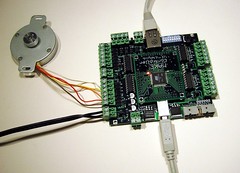
Most 5.25" floppy disk drives have a stepper motor
in them for positioning the head, plus interesting widgets like
optical emitters and detectors. With a little bit of work, they can
be removed and put back into service with your Makezine controller. I put
together a set of photos showing how I disassembled
my floppy disk drive and removed the useful bits.
A stepper
motor has magnets, poles, and windings. The windings go around
the poles, and you energize the windings in a specific order to make
the motor turn in one direction or the other. A motor can have four,
five, or six wires coming out of it. You will need to use an ohmmeter
to determine the meaning of the wires.
- A stepping motor with four wires has only two windings and is
bipolar. You have to be able to drive it with positive and negative
voltages. In order to make the magnets spin around, you need to
energize the windings with positive and positive, then negative and
positive, then negative and negative, then positive and negative. You
don't have to worry about which pairs of wires go with which winding.
Just hook all four up to the digital outputs.
- A stepping motor with five wires has four windings and is
unipolar. One of the wires is a common connection for all four
windings. It will have the same resistance to the other four wires.
Connect that wire to ground and the other four to the digital outputs.
- A stepping motor with six wires has four windings and is unipolar.
One of the wires is a common connection for two of the windings, and
the other for the other. It will have an equal resistance measurement
to two other wires, and infinite resistance to the other three.
Connect both common connections to ground, and the other four to the
digital outputs.
Once you have the motor connected, you will need to drive it with
the correct sequence. Fortunately you can't hurt the motor by giving
it the wrong sequence. It will just flail around helplessly. In the
program below, the sequence is set by "order". It lists the digital
output numbers in the order of the windings. Keep trying orders until
the motor continuously turns in a circle. Note that the software
requires the last of five be the same as the first. Uses an extra
entry to keep the code clean.
Run the program like this. Servo.py emits the OSC commands in the
proper order and schedule. sendOSC hands them off to the Makezine
controller.
./servo.py | (trap "" SIGINT;osc/sendOSC/sendOSC -h 192.168.0.200 10000)
#!/usr/bin/python
"""servo.py -- runs the servo around and around"""

import time, sys

# set this to false to see the LEDs light up like the windings are energized.
if True:
    service = "digitalout"
    command = "value"
    order = [ 4,5,6,7,4 ]
else:
    service = "appled"
    command = "state"
    order = [ 0,1,2,3,0 ]

set = "/%(service)s/%%s/%(command)s " % locals()
set0 = set + "0\n"
set1 = set + "1\n" + set + "1\n"
set2 = set + "0\n" + set + "1\n"

pausetime = 0.05

def run():
    for i in range(0,4):
        sys.stdout.write(set1 % (order[i], order[i+1]))
        sys.stdout.flush()
        time.sleep(pausetime)
        sys.stdout.write(set2 % (order[i], order[i+1]))
        sys.stdout.flush()
        time.sleep(pausetime)

try:
    while True:
        run()
except KeyboardInterrupt:
    for i in range(0,4):
        sys.stdout.write(set0 % (order[i]))
        sys.stdout.flush()
posted at: 01:48 |
path: /opensource |
permanent link to this entry
Mon, 16 Oct 2006
20.32 km 66681.55 feet 12.63 mi
3737.00 seconds 62.28 minutes 1.04 hours 12.17 mi/hr
A beautiful fall ride. A little cool; 57 degrees, but in shorts and
t-shirt. Some pretty leaves still on the trees, but it's "past peak" as most
people say. Hit a new top speed: 37.1 MPH according to my GPS receiver.
Average speed is a little low; stopped in to visit my friend Robin and see
his new house, but he wasn't home.

posted at: 21:59 |
path: /bicycling |
permanent link to this entry
Today, somebody asked me what this meant: "Court thus concluded
that places of public accommodation had no "right" to select guests as
they saw fit, free from governmental regulation." ? I said "It means
that a store-keeper has to subject himself to whatever whim
politicians wish to impose on him." Then I noticed that Jim Crow laws
and Anti-Discrimination laws are opposite sides of the same coin.
They both express the idea that the government can tell you who you
must or must not associate with. I disagree with that. Just because
you admit some or all people to your place of business doesn't mean
that you should be forced to admit all or some people. It's
unfortunate the the forces of good would be so willing to use the tool
that the forces of evil used. I think it would be better if the
forces of good would destroy the tool, lest it fall into the hands of
evil.
Racism is evil; it used the tool of government coercion to force
people to discriminate. Anti-racism is good; it used the tool of
government coercion to force people not to discriminate. I'd prefer
to see that tool destroyed, rather than used for good.
Private entities can still discriminate, or not discriminate. What
is gone is the ability for good people to force everyone to be good,
or for bad people to force everybody to be bad. Everybody agrees that
it was bad when bad people were forcing everybody to be bad. Lots of
people think that it's okay for good people to force everybody to be
good. I think they're missing the fact that the idea of forcing
everybody is the true danger. Just because the good people are in
control now, that doesn't mean that they'll always be in control.
Sometimes discrimination is good. Suppose a black person wanted to
hire only black people in her factory, to help give them a leg up?
She couldn't do that; it would be illegal discrimination. Suppose a
white person feels bad about slavery and wants to enact his own
personal reparations program by paying black people more simply
because they were black. (A black person might want go all cynical on
me right now with a succinct "Ha!" Maybe they're right to be cynical,
but we'll never know if a white person wanted to do that, because it
would be illegal discrimination.)
If people can't be forced to discriminate (as Jim Crow laws did),
and they can't be forced to not discriminate (as Anti-Discrimination
laws do), then there will be some people who discriminate for evil,
some people who discriminate for good, and some people who do not
tolerate any kind of discrimination. I'd rather deal with that than a
world where people accept that it's okay to force people to associate,
or to force them to note associate.
posted at: 04:23 |
path: /economics |
permanent link to this entry
Sat, 14 Oct 2006
Leftists want to treat the minimum wage as a magic bullet. Shoot
it off, and it magically reduces poverty. The problem with any magic
bullet, though, is that it comes down somewhere. With enough margic
bullets, or by affecting enough people with the magic, it
will hit somebody. Leftists try to claim that, because you
can't ever find the bullet, that the bullet somehow disappears.
For a small enough minimum wage increase, you can't identify anyone
whose employment got destroyed because their labor is no longer worth
the minimum wage. You can't even pull out the loss of that job from
all the other changes in the work force. But like the magic bullet,
it has to land somewhere. If you can't identify the person who got
hurt, did they not get hurt?
posted at: 06:26 |
path: /economics |
permanent link to this entry
Mon, 09 Oct 2006
Could there be such a thing as too little unemployment? Leftists
will say "Not for us, but maybe for businesses. They can only exploit
workers when unemployment is high enough to force everybody to take
the first job they can get no matter how lousy. From businesses
perspective, there can definitely be too little unemployment."
If you accept the idea that there is a natural rate of
unemployment, which results from the cultural amount of job-switching,
the acceptance of unemployment, and people's expectations, then yes, a
rate of unemployment lower than that would be a bad thing. It would
mean that the economy is providing sufficient jobs, but that people
don't feel that way. It could also mean that people are reluctant to
stay unemployed for any period of time. They might be expecting bad
times.
It could also be that people don't switch jobs too often, so that
people take a new job because they're scarce. People might not switch
because of benefits designed to retain employees; for example leave
time, or sick days, or liberal sabatticals, or health insurance tied
to employment.
posted at: 05:30 |
path: /economics |
permanent link to this entry
I use four
screens, and sometimes lose my cursor. No more! I have Obi-WanQui-Gon
to point the way for me. Using the Makezine Controller, a
small X program, OSC, and a pair of servo motors, I have a real-life cursor
(2.4MB video).
The X program (included below) tracks the cursor, and ten times a
second, sends an OSC (Open Sound Control) command using sendOSC to the
controller. The commands work together like this:
~/src/servo | osc/sendOSC/sendOSC -h 192.168.0.200 10000
/* compile with this command:
cc servo.c -o servo -L/usr/X11R6/lib -lX11
*/
#include <stdio.h>
#include <X11/Xlib.h>

main(int argc, char *argv[])
{
    Display *dpy = XOpenDisplay(NULL);
    Window thiswindow;
    Window root, child;
    XEvent ev;
    int x, y, oldx, oldy;
    int junk;
    unsigned int state;

    thiswindow = DefaultRootWindow(dpy);
    for(;;) {
        XQueryPointer(dpy, thiswindow, &root, &child, &x,&y, &junk,&junk, &state);
        if (oldx != x || oldy != y) {
            printf("/servo/0/position %d\n/servo/1/position %d\n", x / 3, y * 1024 / 768);
            fflush(stdout);
            oldx = x;
            oldy = y;
        }
        usleep(1000L * 1000L / 10);
    }
}
Digg this!
posted at: 02:34 |
path: /opensource |
permanent link to this entry
Sun, 08 Oct 2006
21.99 km 72150.65 feet 13.66 mi
5870.00 seconds 97.83 minutes 1.63 hours 8.38 mi/hr
Left a geocache on the Rutland today. Just a simple out and back,
complicated only because I took the road around the wetest and mudiest
portion of the trail.

posted at: 22:45 |
path: /bicycling |
permanent link to this entry
Fri, 06 Oct 2006
35.83 km 117556.59 feet 22.26 mi
9834.00 seconds 163.90 minutes 2.73 hours 8.15 mi/hr
This has become more or less my standard ride. Go out on the Rutland, and either return on 11C / 11,
or else return on the Rutland itself. Removed a few fallen branches
from the trail.

posted at: 04:47 |
path: /bicycling |
permanent link to this entry
Tue, 03 Oct 2006
This is the first keyboard produced from measured drawings. I have
a little Python program which generates a full-size postscript
drawing. I print that to sticky paper and stick it on a sheet of
plastic. Then I cut the plastic to the drawing. In this case, I
wasn't using exactly the right plastic. It's .040 polyester.
Polyester is a little flexible, and .040 is a little thin. It's 1mm
thick, and the switches really need 1.2mm to lock in well.
This keyboard is a direct descendant of the Mark VIII
keyboard. That one used a flat plastic platform for the keys just as
this one does. However, it was cut by hand from cardboard and
hot-melt-glued together. This one was cut in a reproducible
manner.
I botched this particular keyboard because I cut some of the key
holes too large, and the keys fall out. Worse, the thinness of the
plastic bears on the hand in certain places and makes it fairly
uncomfortable. This design simply will not work.


posted at: 15:34 |
path: /chordite |
permanent link to this entry
19.41 km 63674.55 feet 12.06 mi
4860.00 seconds 81.00 minutes 1.35 hours 8.93 mi/hr
Went up to Norwood today. Rode east on the Rutland Trail. Moved a few
branches out of the way. There's a tree that needs sawing up before it can
reasonably be moved off the trail.

posted at: 04:20 |
path: /bicycling |
permanent link to this entry